
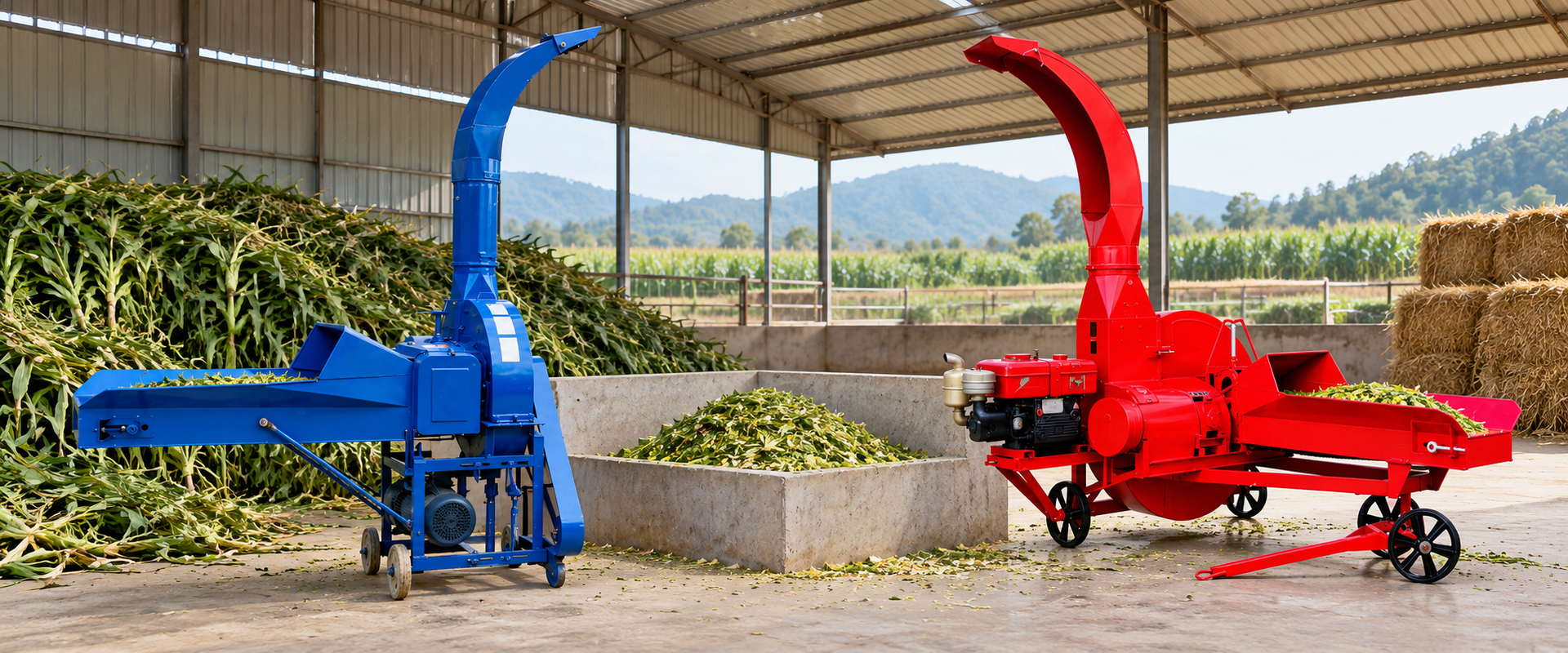
Choose electric when a reliable rated supply reaches the work point; choose diesel when the site is off-grid or the chopper must carry its energy. PTO can suit a route already covered by a tractor. Start with this diesel vs electric silage chopper solution guide, then compare crop flow, field movement, and service access.
A dairy team may cut forage before rain. One farm has a prepared shed; another must move the cutter beside several fields. Match the machine to those conditions.
1. Which Drive Suits a Diesel vs Electric Silage Chopper?
A diesel vs electric silage chopper fits when its drive keeps forage moving through the planned work line. Electric draws site power, diesel carries fuel, and PTO uses tractor power. For a fixed station, compare an electric chaff cutter machine with your feed route.
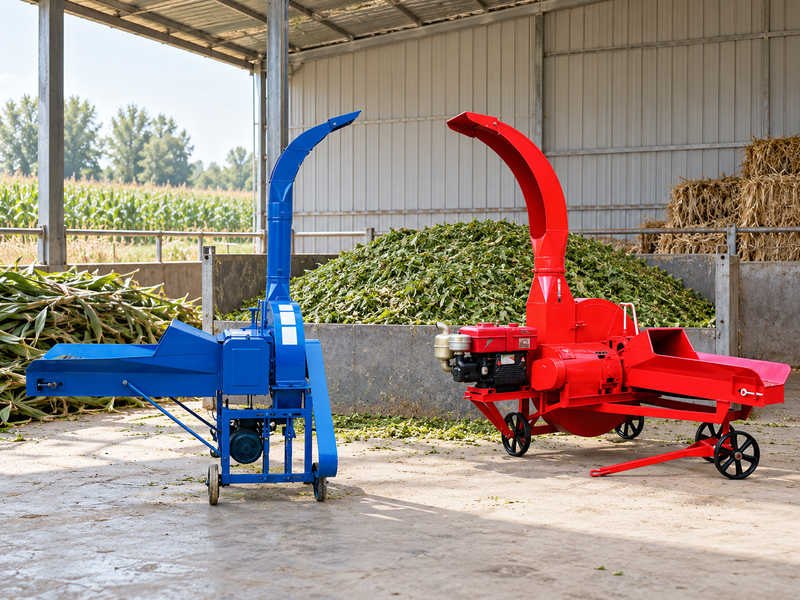
Compare the working drive
An electric drive makes the power path your main site question. Diesel adds fuel, ventilation, and engine service. Both need guarded moving parts.
Trace the work line from power to storage. Keep these actions simple:
- Bring forage to the cutter without repeated lifting.
- Keep feed and discharge visible.
- Stop, isolate, and restart safely.
Match power to daily work
Electric suits a repeatable station. Diesel can follow the crop; PTO may fit when a tractor travels the route.
| Drive | Site question | Fit |
|---|---|---|
| Electric | Can the station supply rated power safely? | Stationary |
| Diesel | Can you store fuel and service the engine? | Mobile |
| Tractor PTO | Can tractor, shaft, and route stay available? | Tractor route |
Electric needs a safe supply, diesel needs fuel and service, and PTO needs an available tractor route. Key Takeaway: choose the drive that keeps your crop route and service routine easiest to manage.
2. What Site Power Does a Diesel vs Electric Chopper Need?
Plan a diesel vs electric silage chopper around the complete power path: supply, placement, and cable or fuel handling. Confirm the electric rating with an installer; for diesel, confirm ventilation and fuel storage.
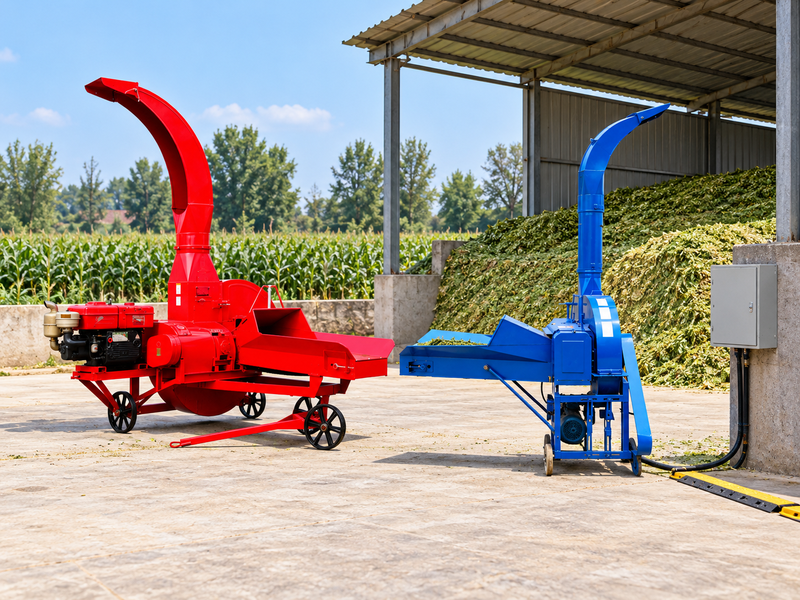
Read your power connection
Begin with the work station. Record the supply point, distance, exposure, protection, and stop method. Keep cable routes clear of vehicles, water, and forage.
Read the site before you size the motor. Use this checklist:
- Identify rated power and supply at the work point.
- Protect cable runs from vehicles, water, and forage.
- Leave space for feeding, discharge, and isolation.
Check the comparison beyond the meter
A side-by-side machine comparison helps compare layouts, while this chaff cutter for small dairy farms in Kenya guide prompts a route review. Walk your shed and field edge. Diesel avoids cable work but needs clear air and fuel.
| Factor | Electric | Diesel |
|---|---|---|
| Work point | Supply and cable route | Ventilation and fuel |
| Operator path | Isolation and footing | Stop and cool-down |
| Service area | Motor and guards | Engine and fuel |
Check supply, cable or fuel route, placement, and isolation together. Key Takeaway: confirm the complete power path before comparing drives.
3. Is a Diesel vs Electric Silage Chopper Easy to Move?
A diesel vs electric silage chopper is easy to move only if its frame, route, and feed setup fit the farm. Diesel carries fuel; electric can move when rated power reaches the planned work point. If forage comes to one station, stationary electric may require less movement, as shown in our diesel powered silage chopper for farms setup.
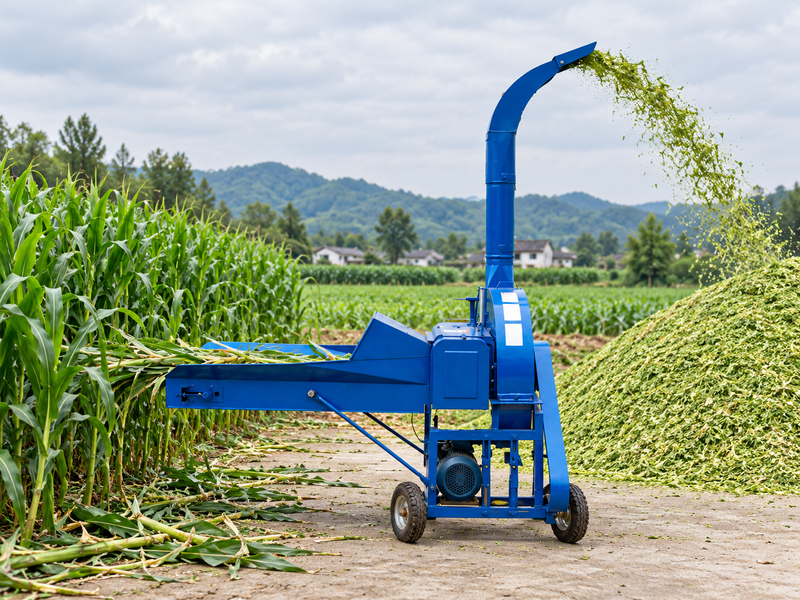
Plan travel between fields
Check gate width, turning space, ground, storage distance, and feed-table position. Park it level, secure it, and clear discharge.
Follow one load, not an ideal route. Note where each option creates work:
- Move the cutter to the crop, or the crop to the cutter.
- Reposition cable, fuel, or tractor between batches.
- Turn without exposing guards or people to traffic.
Use mobility as a workflow choice
FC-6 and FC-9 offer pneumatic tires for repositioning. Inspect the route instead of assuming every surface works. Fixed electric can win when collection is short.
| Route | Likely fit | Check |
|---|---|---|
| One shed, repeated loads | Stationary electric | Power and handling |
| Several crop points | Mobile diesel or PTO | Repositioning |
| Crop arrives by tractor | Stationary unit | Unloading path |
Pneumatic tires help reposition FC-6 and FC-9, but route conditions still decide whether movement is practical. Key Takeaway: choose the position that shortens the whole route, not only the distance to the field.
4. How Do Diesel and Electric Silage Chopper Costs Compare?
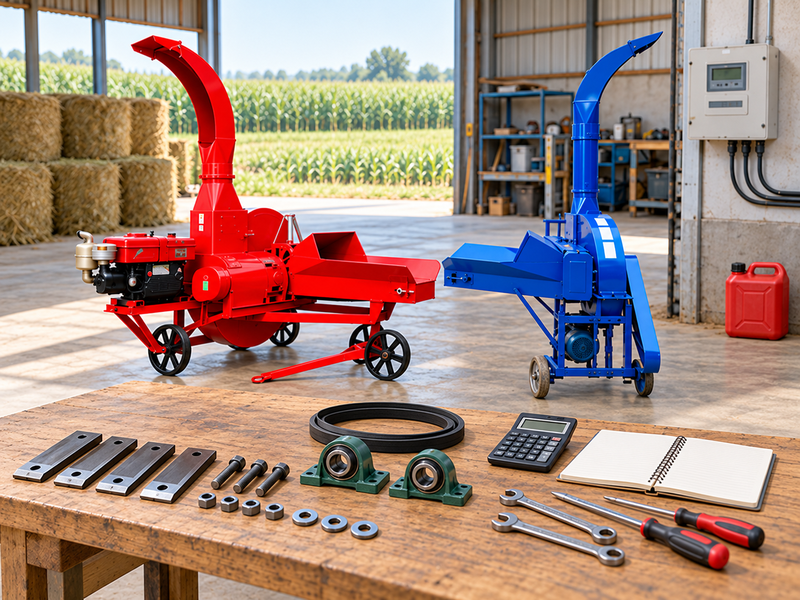
Compare running costs for a diesel vs electric silage chopper with your energy price, operating hours, service records, and consumables. Electric starts with metered energy; diesel starts with fuel. Add maintenance and site preparation to both.
Use a clean running-cost formula
Record one work period. Electric cost is metered kWh used × your tariff; diesel cost is litres consumed during the comparison period × applicable fuel price, with idle consumption included. Add service.
Put the same batch on both sides of the ledger. Track:
- Chopping hours and repeatable crop flow.
- Energy used, with idle time.
- Fuel consumed, including idle consumption.
- Service, consumables, and extra handling time.
Separate machine and site costs
Electric may shift cost toward the fixed site; diesel toward fuel and engine service. Use the same batch and route.
| Cost line | Electric | Diesel |
|---|---|---|
| Energy | kWh × tariff | Consumed litres × applicable price |
| Service | Motor and drive checks | Engine and drive checks |
| Site work | Cable handling | Fuel handling |
Record the same batch and route for both drives, then include energy, service, and site work. Key Takeaway: compare recorded cost per batch or hour using your rates and route.
5. How Do You Maintain Diesel and Electric Silage Choppers?
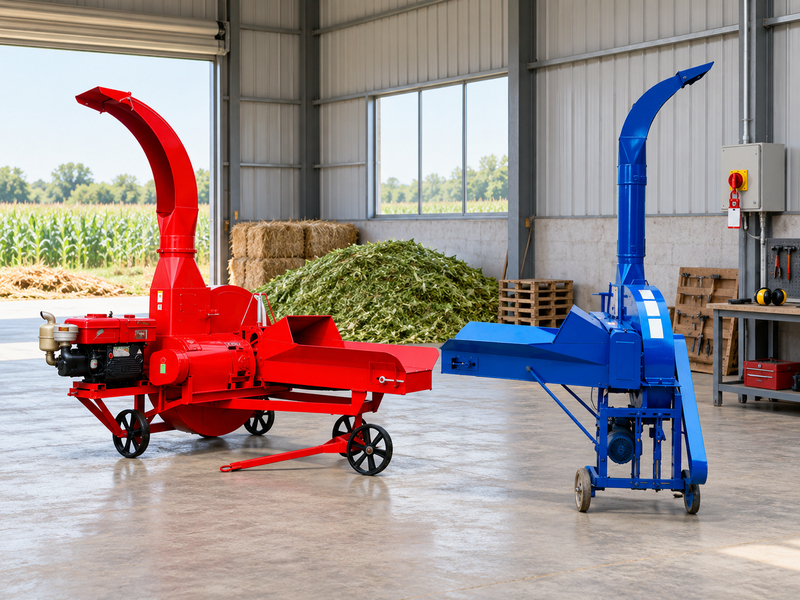
Maintain a diesel vs electric silage chopper safely by isolating energy, securing guards, controlling dust, and planning noise. Use these forage chopper safety checks beside the manual; verify isolation.
Schedule service around the feed line
Stop the drive, isolate it against unexpected restart, and wait for all moving parts to stop before clearing the feed opening or discharge, or opening guards. Follow the manual for stored energy and drive-specific isolation. Diesel needs cool-down and fuel checks; electric needs isolation, motor, belt, and bearing checks. Clear dust and replace guards.
Make the stop state visible before service starts. Put these checks on a short service card:
- The drive is stopped, isolated against unexpected restart, and verified motionless before clearing feed or discharge or opening guards.
- The manual's stored-energy and drive-specific isolation steps are complete.
- Guards, belts, chains, and rollers are secure.
- Switches, cables, fuel lines, and stops are usable.
Control noise and safe access
Noise can rise with engine speed, impact, loose panels, or poor positioning. Keep hearing protection where required; use clear signals and never reach into a feed opening.
| Check | Electric | Diesel |
|---|---|---|
| Isolation | Supply and cable | Engine stop and fuel |
| Moving parts | Motor, belts, rollers | Engine drive, belts, rollers |
| Work area | Footing and cable route | Ventilation and cool-down |
Isolation, moving-part, and work-area checks apply to both drives before maintenance begins. Key Takeaway: service the power source and feed path with equal discipline.
6. Can PTO Replace a Diesel or Electric Silage Chopper?
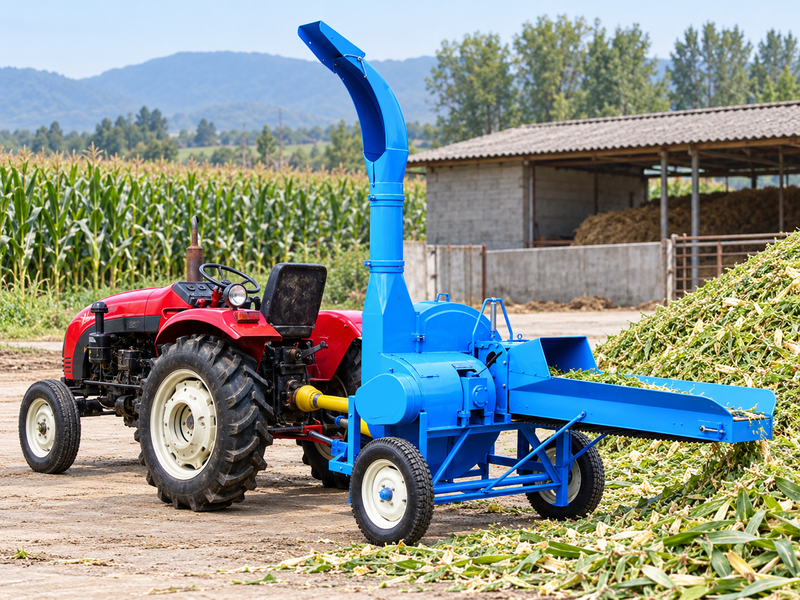
A diesel vs electric silage chopper comparison should include tractor PTO when tractor power, cutter, route, and schedule fit one plan. The tractor chaff cutter avoids a separate engine, but adds shaft guarding and coupling checks.
Check tractor fit
Match the cutter's requirement to usable PTO power and crop load. Listed ranges are FC-2.5 at 12–18 HP, FC-4 at 15–24 HP, FC-6 at 20–35 HP, FC-9 at 35–50 HP, and FC-30 at 80+ HP. These guide selection, not every crop.
Check the shaft before you count tonnes. Confirm:
- PTO speed and shaft length follow instructions.
- Guards stay in place and the tractor can stop before approach.
- Tractor route and operator position stay safe.
Choose PTO when it serves the route
PTO suits routes where the tractor already moves forage; it is inconvenient when committed elsewhere. Compare coupling time with a stand-alone unit.
| Condition | Good sign | Caution |
|---|---|---|
| Tractor access | Already on crop route | Schedule may change |
| Power match | PTO power fits cutter | Avoid blanket HP rules |
| Coupling | Guarded shaft, level area | Never approach active shaft |
PTO fit depends on the tractor route and guarded connection, not power alone. Key Takeaway: choose PTO after checking tractor power, shaft safety, and scheduling together.
7. How Do You Match Diesel or Electric Chopper Capacity?
Match a diesel vs electric silage chopper to capacity by starting with crop flow, daily volume, and chop length. The FC series electric chaff cutter page lists model ranges, but advertised throughput is not a promise for every crop. Confirm crop condition and feed route.
Use advertised model ranges carefully
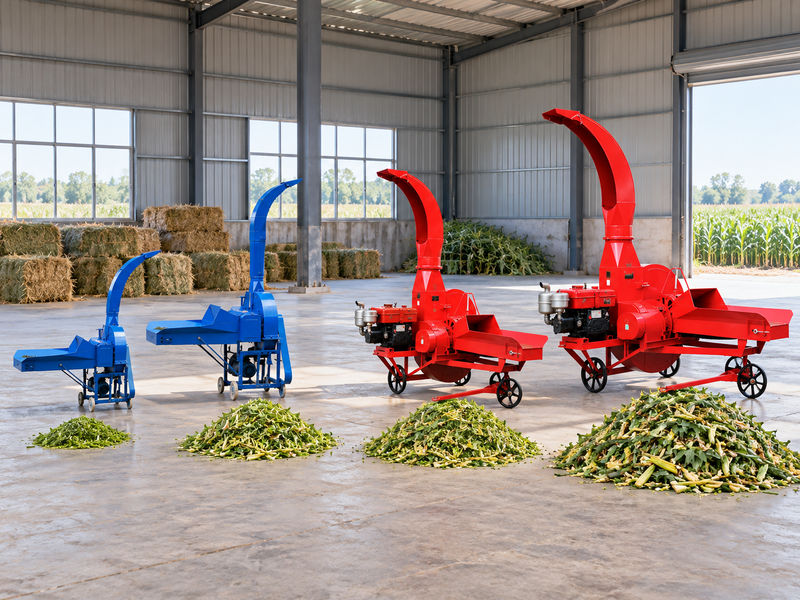
The model table lists FC-2.5 at 1–4 t/h with 4 kW and diesel minimum 8 HP; FC-4 at 2–8 t/h with 5.5 kW and 12 HP; FC-6 at 3–15 t/h with 7.5 kW and 15 HP; FC-9 at 3–20 t/h with 15 kW and 28 HP. Use these to shortlist, then validate crop flow.
Let the feed table set the shortlist. Check:
- Whether forage arrives continuously or in irregular bundles.
- Whether the needed chop length is adjustable.
- Whether discharge reaches storage safely.
Match capacity to crop flow
FC-4, FC-6, and FC-9 include a chain conveyor and feed rollers; FC-6 and FC-9 offer pneumatic tires. Adjustable chop length is 10–30 mm, a machine range to confirm, not a feeding prescription. FC-30 supports up to 30 t/h; do not apply it to all heavy-duty models.
| Model | Motor | Range | Diesel min. |
|---|---|---|---|
| FC-2.5 | 4 kW | 1–4 t/h | 8 HP |
| FC-4 | 5.5 kW | 2–8 t/h | 12 HP |
| FC-6 | 7.5 kW | 3–15 t/h | 15 HP |
| FC-9 | 15 kW | 3–20 t/h | 28 HP |
Use the table to shortlist models; crop flow and storage route decide the fit. Key Takeaway: select enough capacity for real feed flow, then verify drive and route as one system.
8. Which Diesel or Electric Silage Chopper Fits Your Workflow?
Choose the silage chopper that fits your farm workflow by checking power, movement, capacity, labour, safety, service, and storage as one sequence. A diesel vs electric silage chopper decision gets clearer when you write those conditions down. Use the chart as a map.
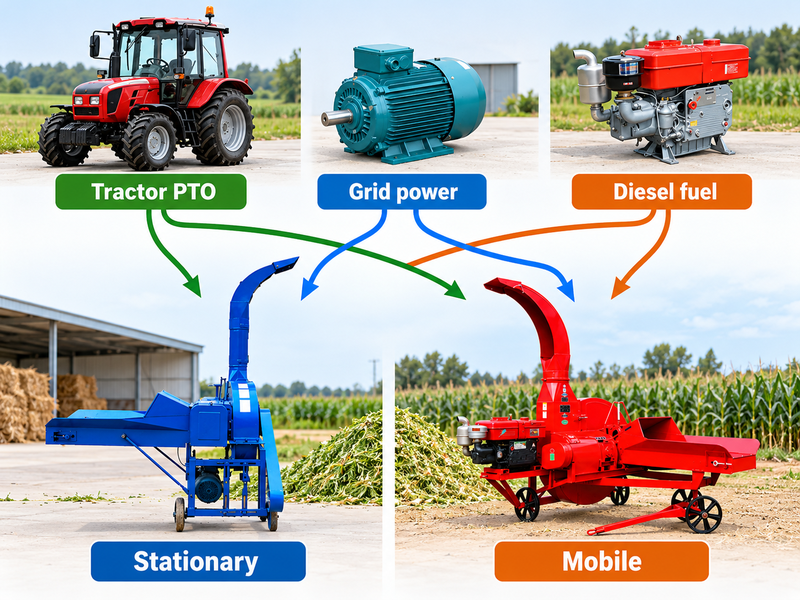
Score the farm conditions
Walk the route with the person who will feed the machine. Record the power point, field distance, crop arrival pattern, chopping window, storage, service, and cleaning.
Walk the shortlist through a normal workday. Tick each item that is clear:
- Power source and isolation point are available.
- Crop reaches the feed opening without awkward lifting.
- Chopped forage leaves discharge without repeated handling.
Build a short decision list
Give each option a practical answer. Record any new cable route, tractor schedule, or longer carry beside rated power and capacity. A short list makes the supplier conversation precise.
| Question | Record |
|---|---|
| Power | Grid, diesel, or PTO |
| Movement | Stationary or mobile |
| Work rate | Crop flow or storage window |
Record an option only when its power, movement, and work-rate answers are clear. Key Takeaway: keep the option that solves the full workflow with few uncertain steps.
9. How Should You Choose a Diesel or Electric Silage Chopper?
Before buying, define how a diesel vs electric silage chopper will receive forage, use power, move, and reach storage. Start with this farm chopper comparison guide, then write your brief.
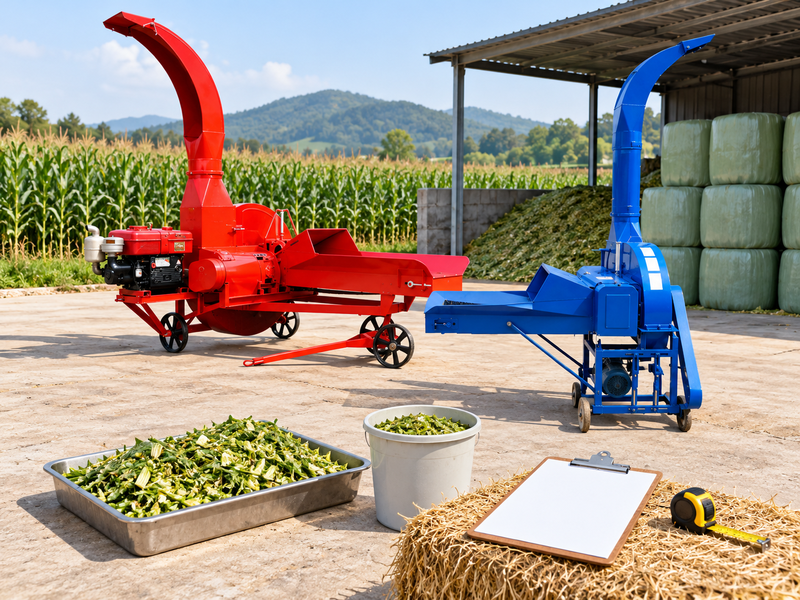
Turn the comparison into actions
Measure the route, identify power, estimate crop flow, choose mobility, and list service conditions. Confirm chop length and discharge. Compare drive and model range with the workday.
Bring the farm evidence to the quote. Prepare:
- Sketches or photos of power, field entrance, and storage.
- Crop type and batch size.
- Tractor details if PTO is under consideration.
- Questions about guards, feed rollers, maintenance, and support.
Prepare a supplier brief
Ask for a recommendation that explains fit, assumptions, and checks needed on site. Treat advertised throughput as a starting range and ask how crop condition may change it. Keep the choice safe.
| Brief item | Answer |
|---|---|
| Power | Electric, diesel, or PTO |
| Movement | Fixed, field-to-field, or tractor route |
| Capacity | Crop flow and work window |
| Service | Who checks guards and feed path |
Give the supplier those four facts, then contact us to discuss equipment that matches actual farm conditions and test the fit against a real workday. Key Takeaway: a responsible supplier matches power, crop flow, movement, and service access.
10. What Should You Ask About Diesel vs Electric Choppers?
Ask about site power, movement, capacity, safety, and service before choosing a diesel vs electric silage chopper. Tie questions to one crop batch and storage path.
Can I run an electric chopper at any farm site?
No, an electric chopper needs a suitable rated supply, protection, safe cable routing, and an isolation point. Check the site with an installer.
What's the best choice for moving between fields?
Diesel or PTO usually suits a moving route better, but the choice depends on gates, ground, tractor, fuel, and storage. Stationary electric can win when bringing forage to one station is easier.
Turn those questions into a site check. Ask:
- Where will the machine stand during a normal batch?
- Who will feed, stop, clean, and service it?
- How will chopped forage reach storage?
How do I know if my power and capacity match?
They match when the site supplies the rated drive, feed flow stays steady, and discharge can handle the material. Compare work records with the model range, then confirm assumptions. Key Takeaway: choose drive and capacity as one workflow decision, with safety and service included.
