
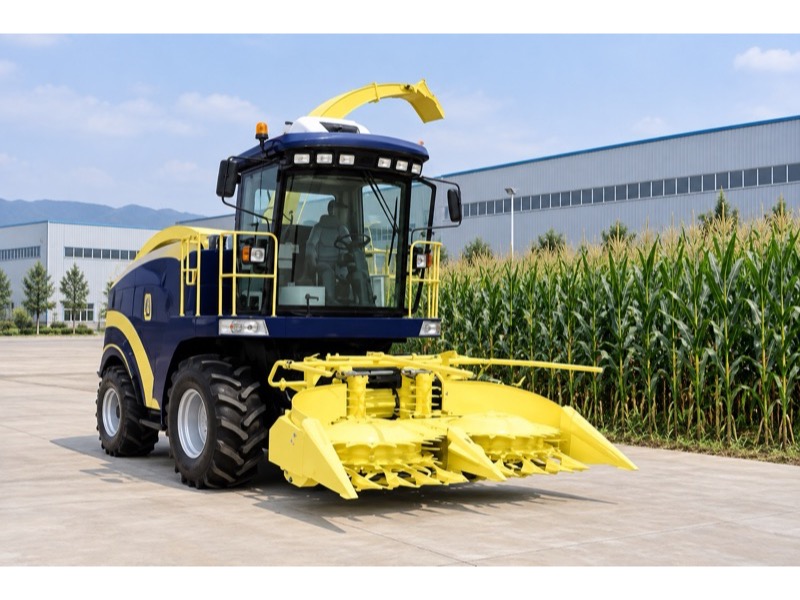
Self-Propelled Forage Harvester: How to Get Better Results
A self-propelled forage harvester picks up or cuts forage, meters crop into a cutterhead, and directs chopped material into a transport vehicle. Header choice, crop condition, chop settings, and trailer coordination determine how well that process works.
When a transport vehicle arrives late, even a powerful harvester must slow or stop while a narrow weather window closes. Poorly matched headers or unchecked crop samples can create another delay at storage. Understanding each crop-flow stage helps you plan useful capacity instead of buying an impressive engine with an unfinished harvest system.
What makes a self-propelled forage harvester different?
A self-propelled forage harvester combines its own engine, cab, crop-processing path, and field drive in one mobile machine. Unlike a pull-type unit, it does not depend on a separate tractor for propulsion during harvesting.
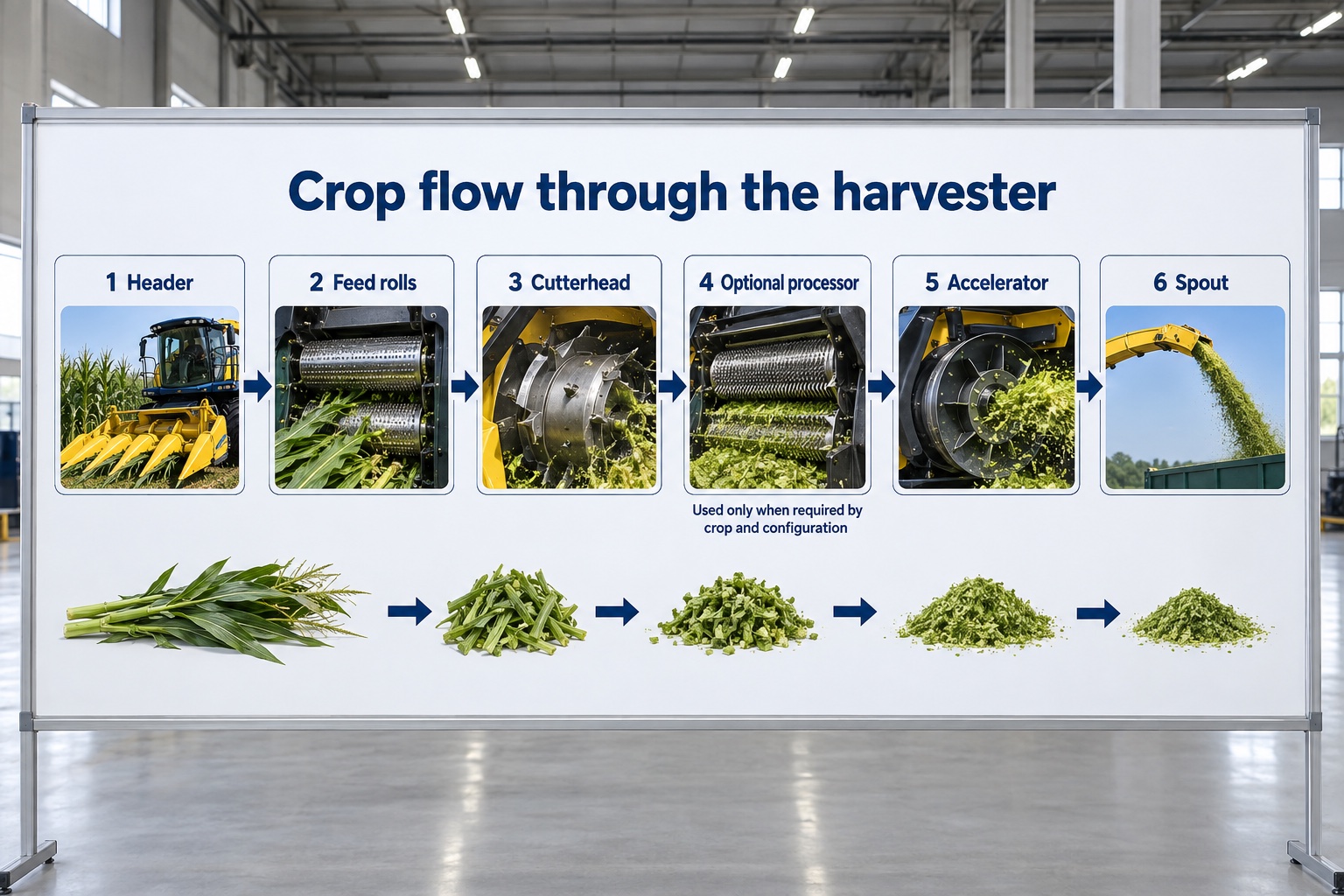
How does the whole self-propelled forage harvester path fit?
Follow material flow rather than headline horsepower. A header gathers crop, feed rolls form a controlled mat, and a cutterhead chops that material. An accelerator then moves output toward an adjustable spout and waiting vehicle.
- The header must suit standing or pre-cut crop.
- Feed components must deliver a steady crop mat.
- Cutting settings must produce usable physical output.
- Transport must keep pace with discharged material.
Can a self-propelled forage harvester replace a yard cutter?
No; a stationary chaff cutter processes crop after another system delivers it. A self-driven harvester performs mobile field work and must also provide suitable visibility, traction, steering, and crop-transfer control.
| Machine type | Main job | Separate power unit required for travel? |
|---|---|---|
| Self-propelled harvester | Mobile field harvesting and chopping | No |
| Pull-type harvester | Field harvesting behind a tractor | Yes |
| Stationary cutter | Yard preparation of delivered forage | Not used for field travel |
Key Takeaway: Judge the complete crop path, field mobility, and logistics together. An independent engine changes how the machine travels, but useful output still depends on every processing stage.
How does a self-propelled forage harvester collect crop?
The self-propelled forage harvester uses a crop-specific header to cut standing plants or collect material already lying in a swath. Header design affects what enters, how evenly it feeds, and whether your crop reaches processing without excessive loss or contamination.
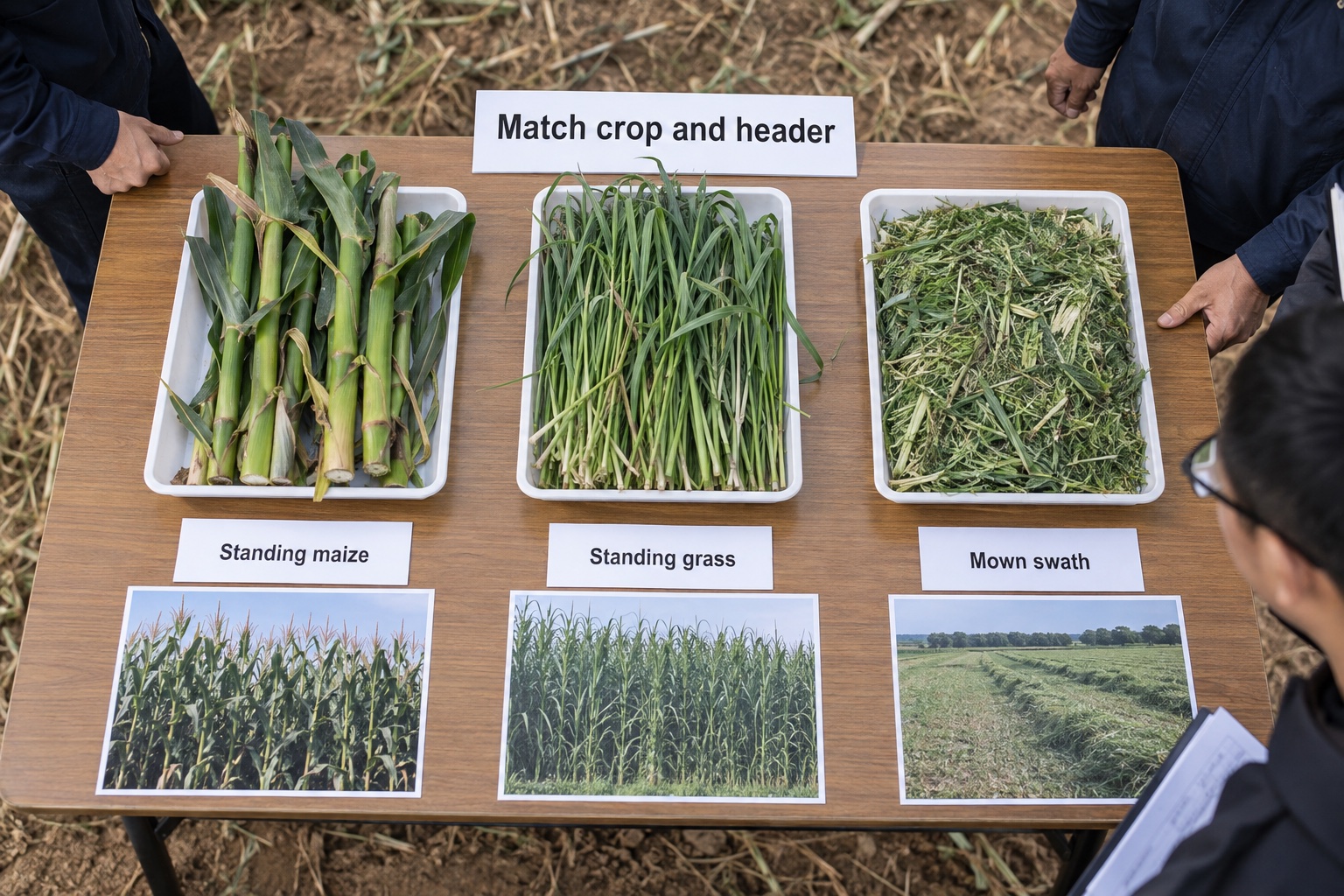
Which header arrangement fits each crop condition?
Start with the crop before choosing width. Standing maize usually needs a row-crop or rotary intake suited to stalks. Grass may use a direct-cut arrangement, while mown forage calls for a pickup designed around formed swaths.
- Identify standing, lodged, or mown crop conditions.
- Describe stem strength, density, and field surface.
- Confirm each proposed header’s approved application.
- Request a trial under comparable field conditions.
What can a self-propelled forage harvester trial miss?
A short pass in light crop may not reveal feeding difficulty, ground following, or losses in dense areas. Use the site’s forage-material guide to document moisture, maturity, and stem condition before comparing results.
| Field condition | Header question |
|---|---|
| Standing tall crop | How does intake handle normal stems and lodging? |
| Mown grass swath | Does pickup follow ground and feed evenly? |
| Uneven or wet ground | What operating limits and adjustments apply? |
Key Takeaway: Match header design with crop presentation, not crop name alone. A clean field photo cannot establish performance in lodged, uneven, or contaminated material.
How do self-propelled forage harvester feed rolls work?
Feed rolls in a self-propelled forage harvester grip incoming forage and form a consistent mat before cutting. Their speed and pressure help determine feed rate and theoretical cut length, subject to each model’s operating design.
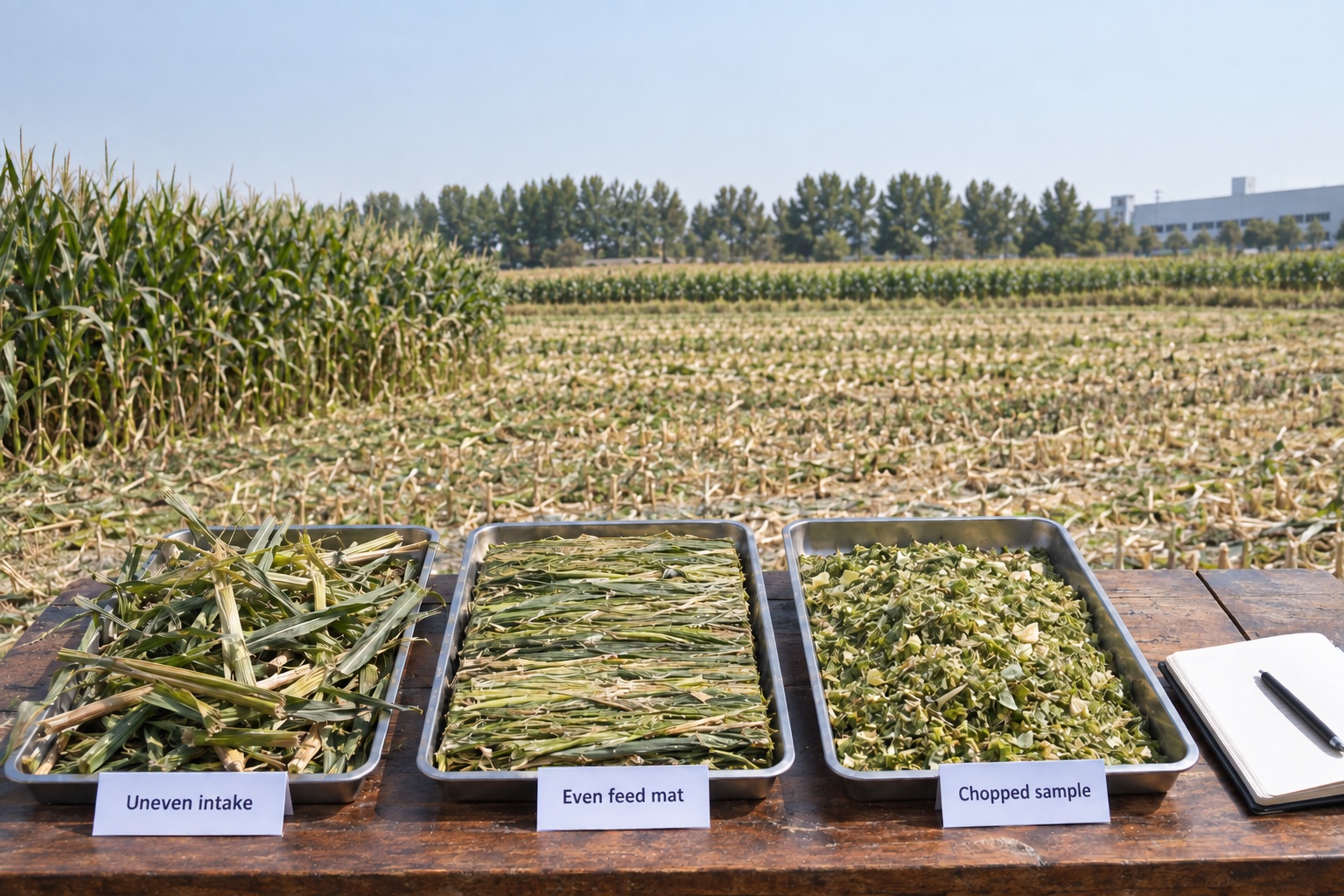
Why does an even feed mat matter?
Uniform flow gives the cutterhead a fair chance. For example, gaps and sudden slugs change loading through crop-processing components. They can also make a short sample look less consistent, even when a nominal setting remains unchanged.
- Watch crop entry across the full header width.
- Note bunching, hesitation, and sudden intake surges.
- Keep representative forward speed documented.
- Inspect output throughout a complete field pass.
Can feed-roll speed alone set final particle size?
No; cutterhead configuration, knife condition, crop moisture, and subsequent processing also matter. Ask suppliers how available feed-roll settings interact with each installed crop-processing component.
| Crop-flow factor | What it influences |
|---|---|
| Feed-roll speed | Material advance toward cutterhead |
| Feed-mat consistency | Loading and chop consistency |
| Crop condition | Compression, feeding, and discharge behavior |
Key Takeaway: A steady feed mat supports repeatable cutting and sensible capacity measurements. Diagnose uneven intake before treating another speed setting as a complete solution.
How does a self-propelled forage harvester chop crop?
A self-propelled forage harvester uses cutterhead knives and a stationary cutting edge to reduce crop mats into shorter pieces. Actual output reflects knife condition, crop flow, selected settings, and crop characteristics during that pass.
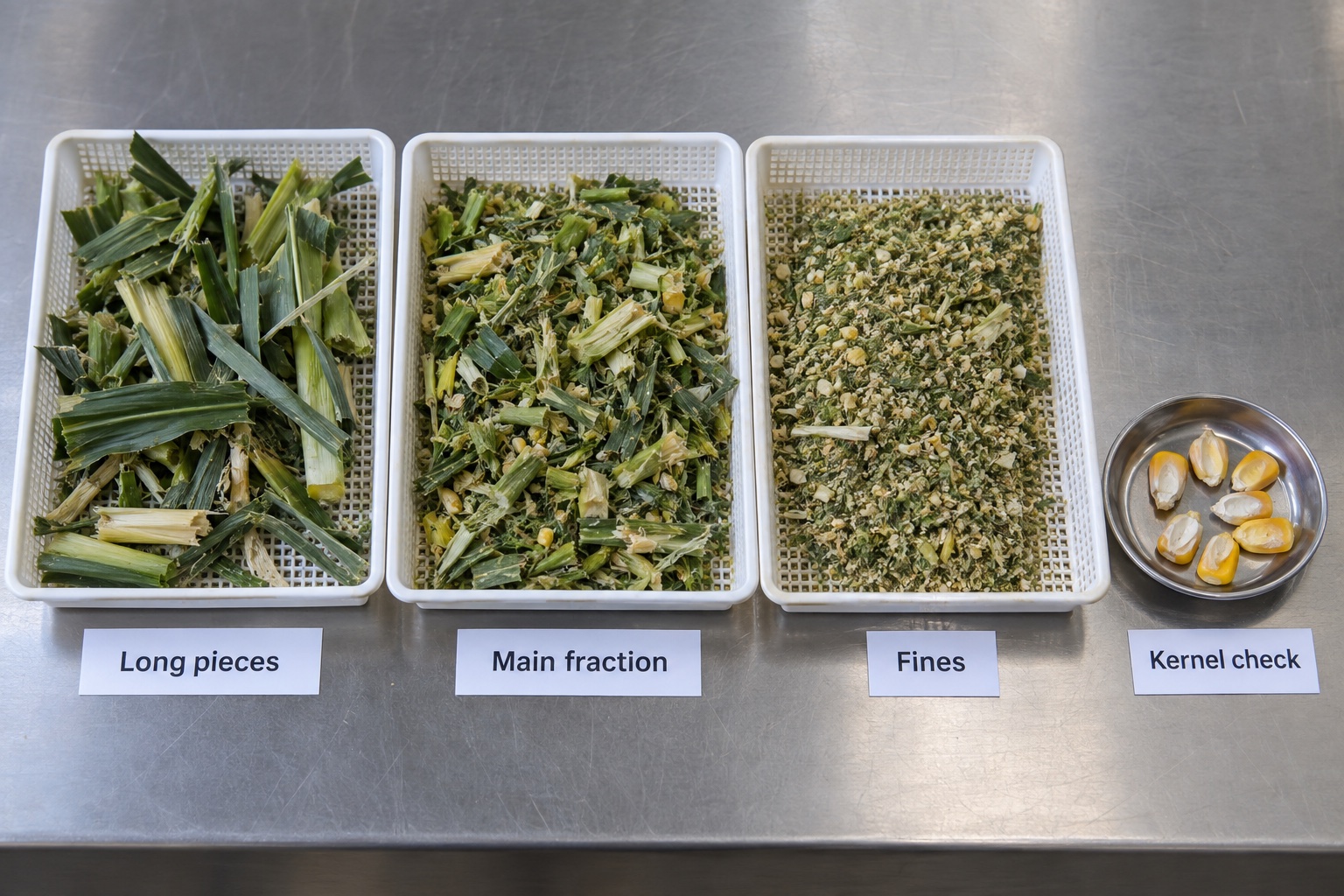
What should a self-propelled forage harvester sample show?
Check distribution rather than one attractive handful. Look for remaining long pieces, the main chopped fraction, excessive fines, and visible contamination. Penn State harvest guidance advises checking forage particles because physical results can change with crop conditions.
- Take samples from several loads or field areas.
- Use a consistent particle-separation method when suitable.
- Record crop moisture and machine settings with samples.
- Review output against storage and ration requirements.
Does a shorter setting always improve silage?
No; very long material can hinder packing, while excessive size reduction may weaken effective fiber. Our corn silage harvest guide explains why crop moisture, processing, packing, and storage must support one another.
| Sample observation | Practical response |
|---|---|
| Too many long pieces | Review intake, knife condition, and settings |
| Excessive fines | Recheck target and processing intensity |
| Changing output | Compare crop condition and component wear |
Key Takeaway: Use representative samples as your operating evidence. A dashboard setting describes machine intent, while collected forage shows what your storage crew and animals actually receive.
When does a self-propelled forage harvester process kernels?
An optional processor in a self-propelled forage harvester matters when whole-crop maize contains kernels that your silage plan requires cracking. Grass harvesting normally follows a different crop path and does not need maize-kernel processing.
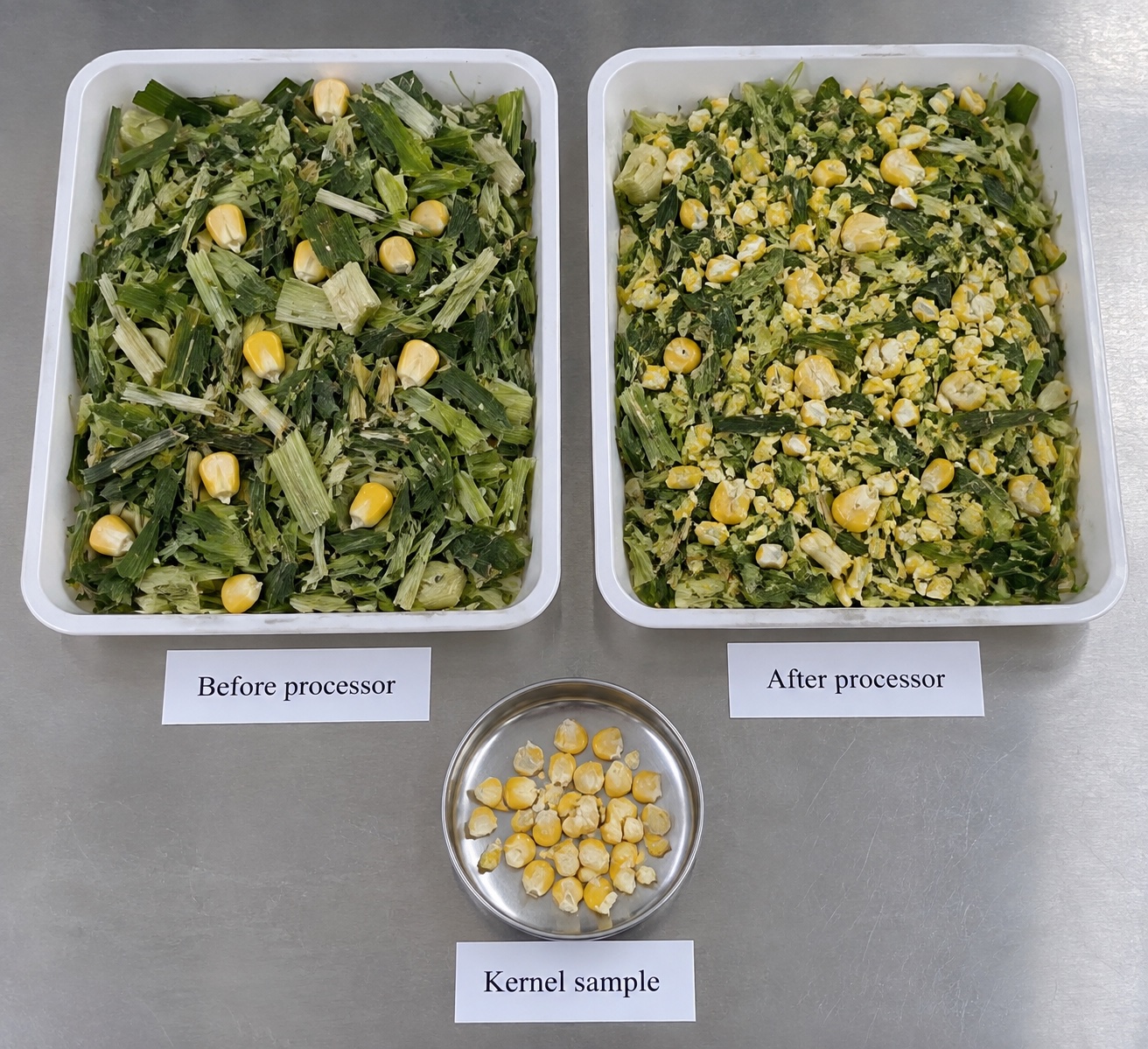
What happens after maize leaves the cutterhead?
Treat processing as a separate quality check. Roller-type systems can act on chopped maize after cutting, depending on configuration. Crop maturity, roller condition, clearance, and speed relationship affect what happens to kernels and cob material.
- Confirm whether a processor is installed and required.
- Inspect kernels across representative harvested samples.
- Follow model procedures for settings and maintenance.
- Remove or bypass components only as instructions permit.
Can a self-propelled forage harvester correct every problem?
No; it cannot repair unsuitable crop moisture, poor cutting, delayed transport, or weak packing. Keep kernel breakage, forage particle distribution, and storage preparation as related but distinct checks.
| Crop or application | Processing question |
|---|---|
| Whole-crop maize | Are kernels and cob pieces treated as required? |
| Grass or alfalfa | Is a processor needed in this crop path? |
| Changing maturity | Do samples still meet agreed physical criteria? |
Key Takeaway: Fit optional processing to crop and end use. More mechanical action adds power demand and wear, so require a useful result rather than assuming every attachment improves feed.
How does a self-propelled forage harvester fill trailers?
The self-propelled forage harvester uses moving-air and crop-acceleration components to send chopped forage through an adjustable spout. Its operator coordinates discharge direction with a transport driver so material lands inside the receiving vehicle. See how the harvester, trailers and bunker work together in a complete maize silage line.
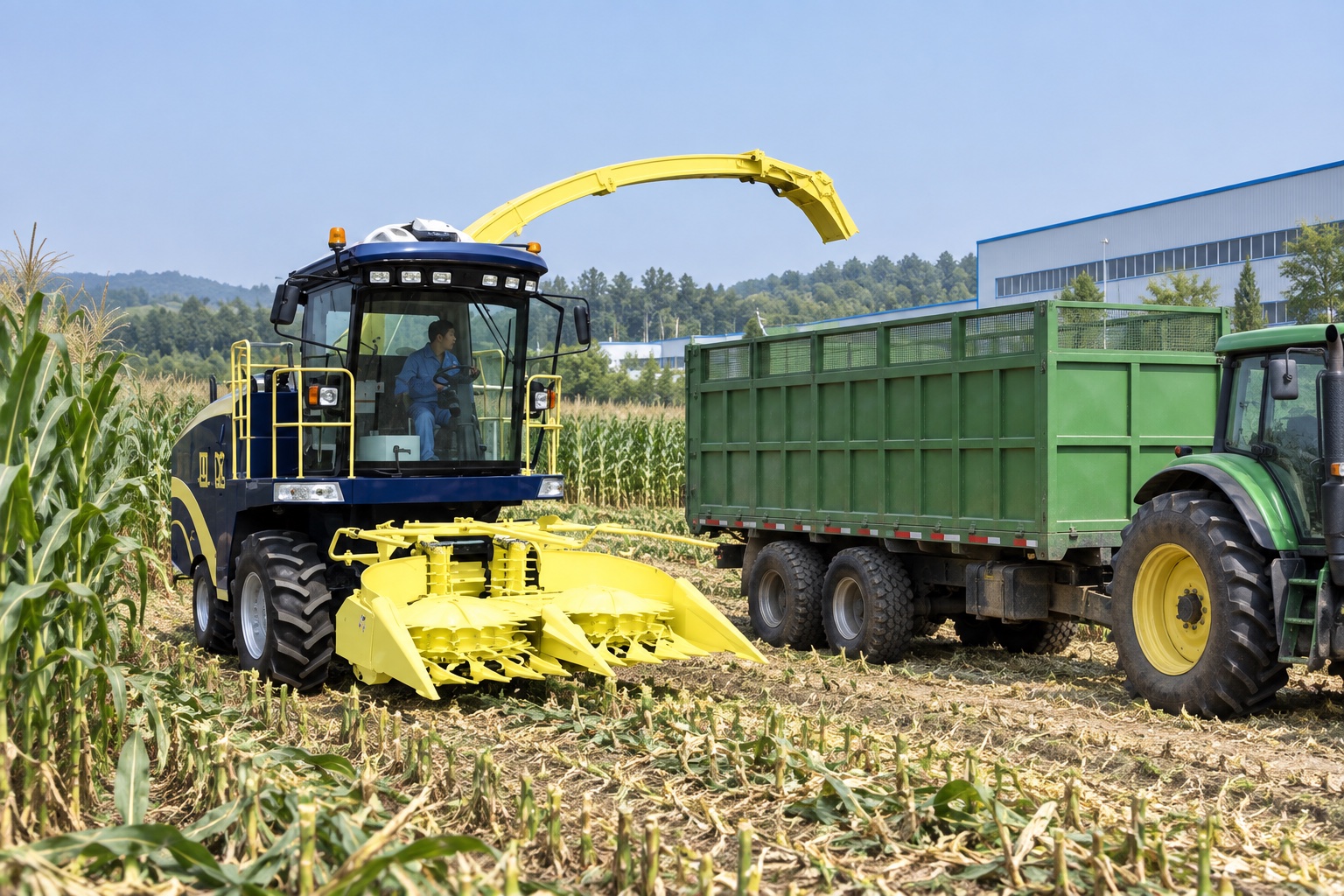
What makes trailer filling steady?
Crop flow must stay continuous through the final stage. Spout position, vehicle spacing, wind, forward speed, and trailer movement affect filling. Clear communication reduces abrupt maneuvers and material thrown beyond receiving sides.
- Agree field signals and vehicle routes beforehand.
- Match trailer height with available spout movement.
- Keep people away from discharge and vehicle paths.
- Monitor fill distribution without unsafe distractions.
Does the spout create silage by itself?
No; it transfers prepared crop into transport. Forage must still reach storage, receive suitable packing, and become sealed within a workable silage-making schedule.
| Transfer variable | Coordination need |
|---|---|
| Crop discharge rate | Receiving vehicle keeps pace safely |
| Trailer fill pattern | Driver and operator coordinate position |
| Travel to storage | Enough vehicles prevent field waiting |
Key Takeaway: The spout connects harvesting with transport. Smooth discharge loses its value when trailers queue poorly, spill crop, or deliver more material than storage can handle.
How does a self-propelled forage harvester operator adjust flow?
The operator of a self-propelled forage harvester adjusts travel, header behavior, crop settings, and discharge coordination as conditions change. Clear visibility and useful machine information help, but regular physical samples remain necessary.
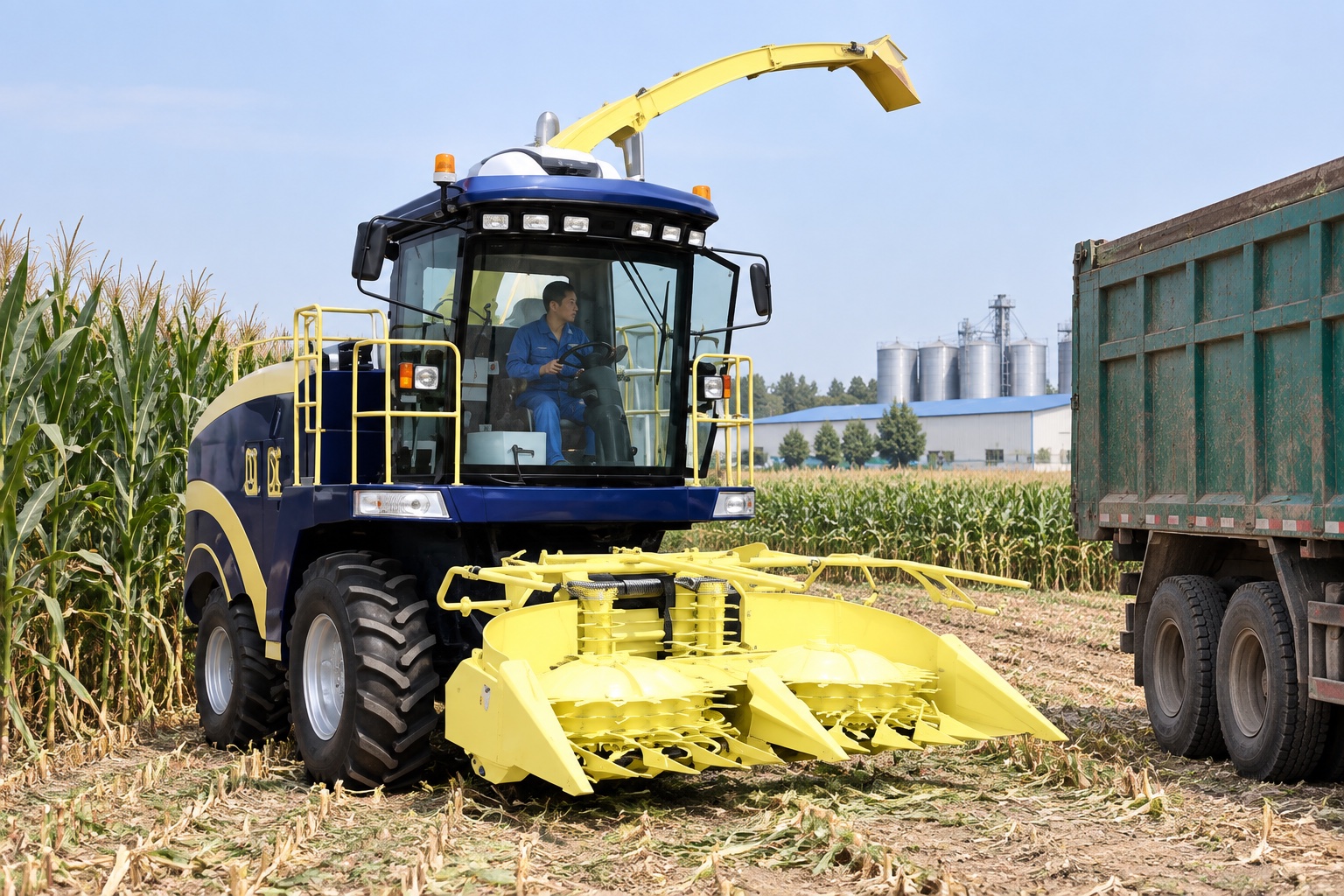
Which observations matter during each field pass?
Watch machine load and crop response together. A denser swath can increase crop flow without any change in travel speed. Operators should notice intake behavior, blockages, output consistency, field losses, and receiving-vehicle position.
- Adjust travel within approved operating limits.
- Recheck output after crop conditions change.
- Keep mirrors, cameras, and windows clean.
- Record recurring delays for later diagnosis.
Can sensor readings replace crop sampling?
No; electronic measurements support decisions only within their installed functions and calibration limits. However, physical forage inspection and independent testing still matter when moisture or composition affects harvest decisions.
| Information source | Best use |
|---|---|
| Cab display | Monitor installed machine functions |
| Physical sample | Check chop and processing results |
| Field record | Compare delays, settings, and conditions |
Key Takeaway: Combine operator judgment, machine information, and crop samples. Any one source alone can miss changes that affect useful field output or storage performance.
What limits self-propelled forage harvester capacity?
Effective self-propelled forage harvester capacity is limited by crop flow, field layout, turning, trailer availability, and storage handling. Engine output matters, but a whole-shift plan determines how much useful forage reaches storage.
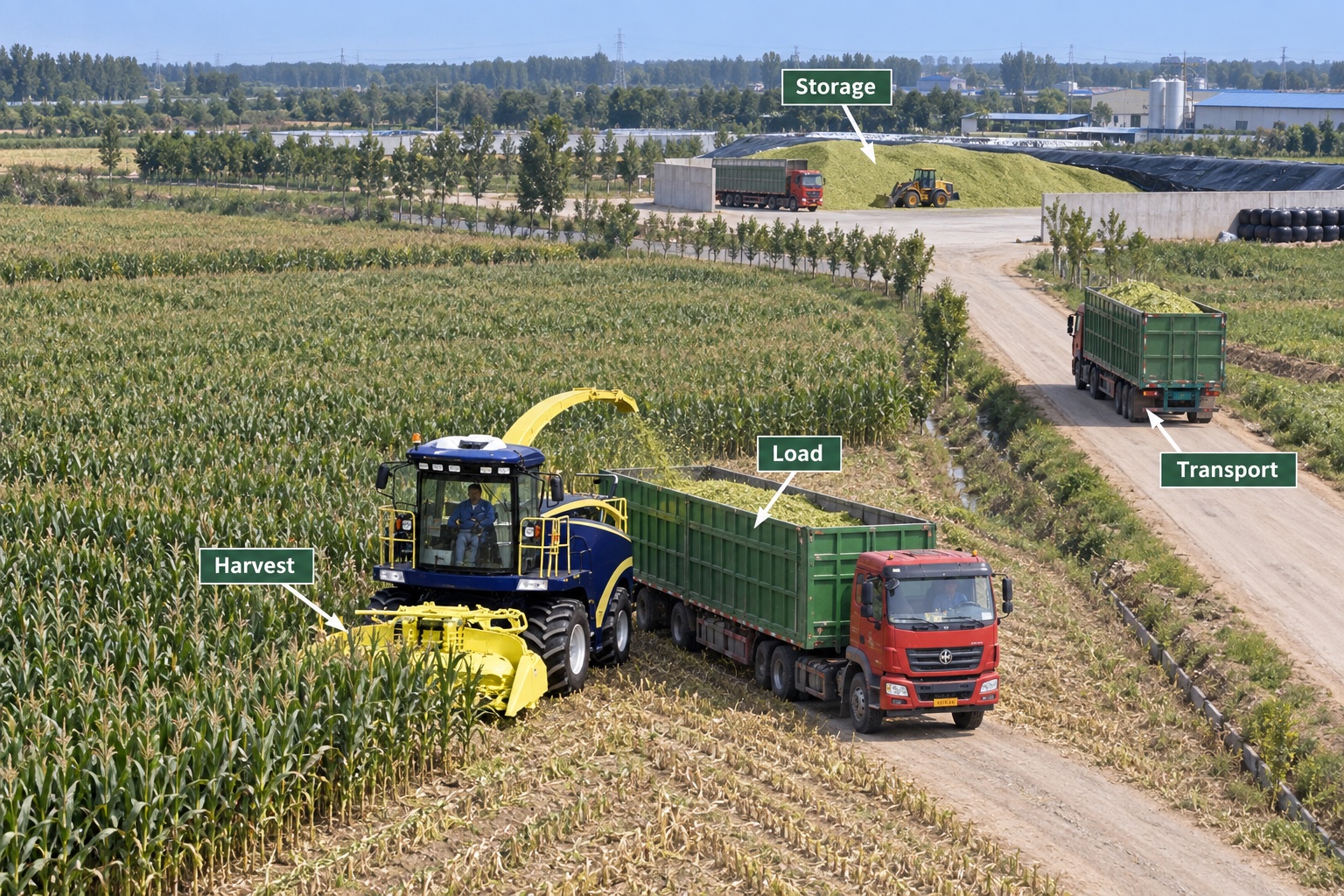
How should you measure practical capacity?
Use consistent time boundaries throughout. Divide completed field area or delivered crop mass by actual field time, including ordinary turns and waiting. Keep road travel, daily service, and storage work visible when planning a full shift.
- Record area and crop mass using reliable methods.
- Separate active harvest from transport waiting.
- Track crop yield and field conditions.
- Repeat measurements across representative fields.
Where does a high-capacity machine lose time?
Small fields, long headland turns, delayed trailers, changing crop density, and storage queues all reduce effective output. Meanwhile, improving one bottleneck simply moves the constraint when another stage lacks capacity.
| Constraint | Useful evidence |
|---|---|
| Field layout | Timed passes and turns |
| Trailer supply | Complete load-return cycle |
| Storage handling | Delivered tonnes handled per hour |
| Crop condition | Yield, moisture, and flow observations |
Key Takeaway: Measure finished harvest flow rather than uninterrupted chopping alone. Extra engine capacity cannot shorten a trailer queue or pack forage after it reaches storage.
How should you compare a self-propelled forage harvester?
Compare each self-propelled forage harvester against your crops, headers, processing needs, fields, transport fleet, and service plan. Require representative field evidence and an itemized configuration before evaluating purchase cost.
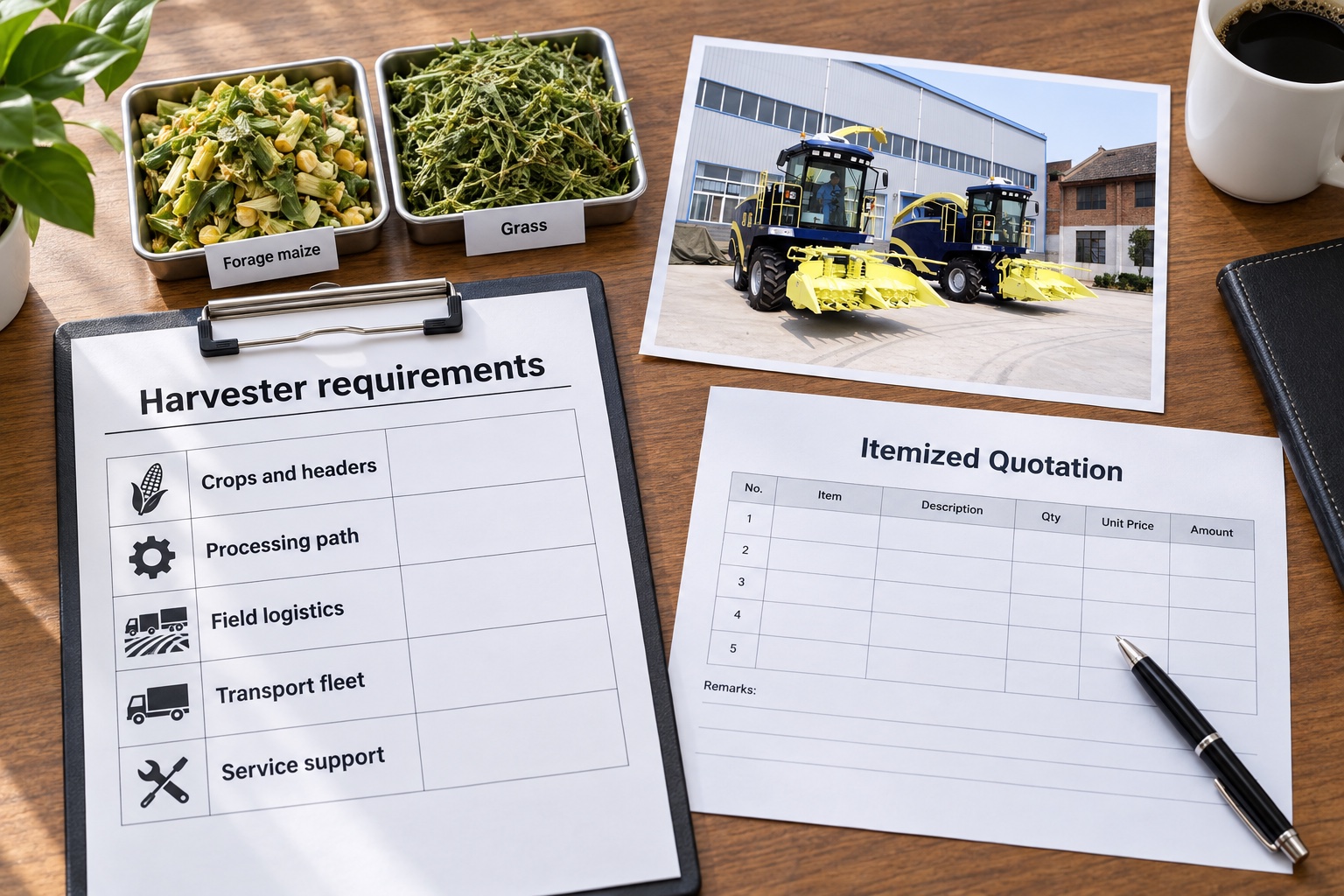
What should a self-propelled forage harvester supplier confirm?
Build the quotation around your operation. State crop types, annual area, likely harvest windows, desired storage system, and available vehicles. Ask which functions, headers, processors, controls, and safety provisions come with the exact machine offered.
- Request crop-specific field demonstrations where practical.
- Compare useful output and fuel or energy records.
- Obtain transport dimensions and header arrangements.
- Confirm manuals, training, service, and wear parts.
What makes a purchasing decision defensible?
| Requirement | Evidence before ordering |
|---|---|
| Suitable crop intake | Approved header and relevant field trial |
| Useful processing | Representative forage and kernel samples |
| Workable harvest pace | Field, transport, and storage timing |
| Continued operation | Instructions, parts, training, and support |
Key Takeaway: You now have a crop-flow framework for comparing machines. Close each evidence gap before treating horsepower, header width, or automation as proof of better harvest results.
For help reviewing a suitable configuration, contact us today with your crops, annual area, storage method, and transport plan. We can discuss the equipment functions and trial evidence needed for a practical proposal. We believe field performance should be measured by usable forage delivered safely to storage.
What else should you know before harvesting? (FAQ)
A self-propelled forage harvester works best when its header, processing path, transport plan, and safety procedures match your operation. These questions address common gaps between a product description and real field work.
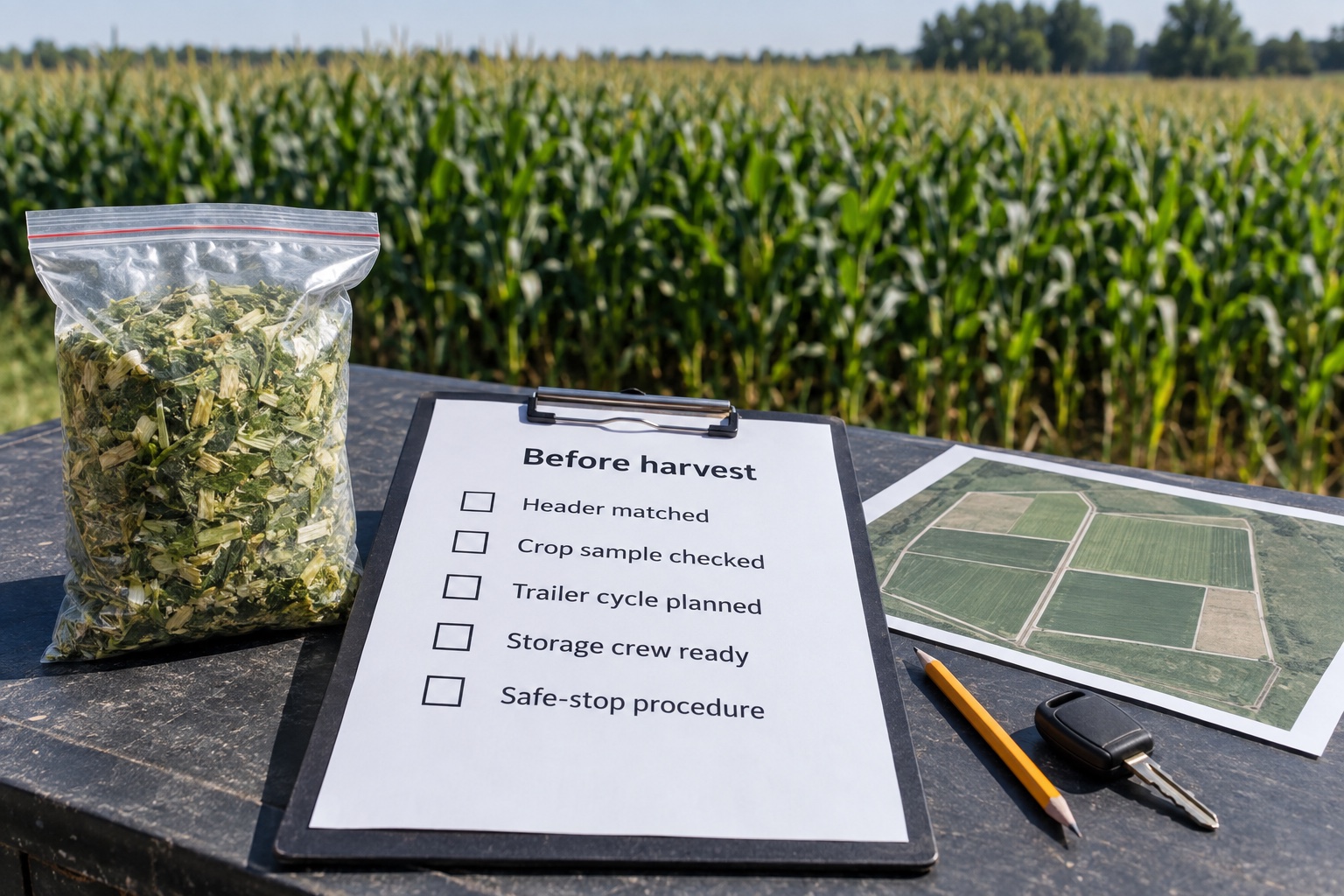
Which final checks should stay with your harvest plan?
Keep the written answers where operators can use them. Update them whenever headers, crops, trailers, or storage arrangements change.
- Confirm crop-specific machine settings.
- Keep representative sample checks documented.
- Review safe-stop and blockage procedures.
Q1: Can I use one header for maize, grass, and haylage?
Only if your manufacturer approves those crops and field conditions for that header. Different crop presentations often require separate standing-crop or pickup arrangements.
Q2: What’s the best chop length for every crop?
There is no single setting for every crop, ration, and storage system. Agree physical targets with your advisers, then verify actual harvested samples.
Q3: How do I know whether I need a kernel processor?
Check your crop and required maize-silage result. Grass work normally does not require maize-kernel processing, while whole-crop corn may need a suitable installed processor.
Q4: Can sensors guarantee consistent silage quality?
No; sensors can support decisions within their installed functions and calibration limits. Crop readiness, physical sampling, transport, packing, and sealing still need management.
Q5: What’s the safest way to clear a blockage?
Follow the operator manual and forage-harvester safety guidance. Isolate power, prevent restart, wait for run-down, secure stored energy, and use only approved methods.
